
Implementation
KDEs and CTEs Without the Jargon: A Worked Example from Receiving to Shipping
One lot of ready-to-eat salad, followed through a plant, with every record the rule expects at each step and the exact point where most operations lose the thread.
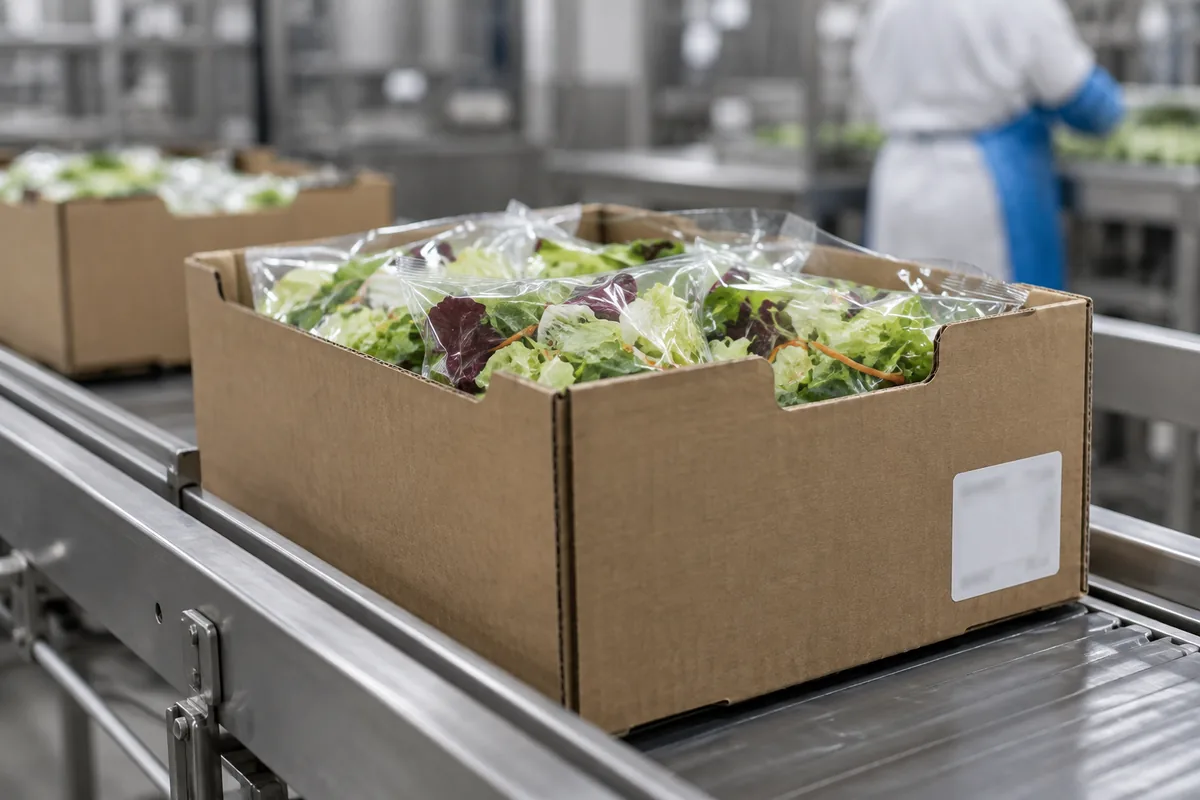
Two acronyms carry most of the confusion in this rule. A critical tracking event is a moment when records have to be created. A key data element is a specific fact you have to record at that moment. Events are when. Data elements are what.
The clearest way to see how they fit together is to follow one lot. Here is a fictional but ordinary Tuesday at a fresh-cut processor that makes a retail ready-to-eat salad.
07:10 — Receiving
Two pallets of chopped romaine arrive from a grower-packer, and one pallet of shredded carrot from a second supplier. Both are listed foods: fresh-cut leafy greens and a fresh-cut vegetable other than leafy greens.
Receiving is a critical tracking event, and it demands, for each incoming lot:
- The traceability lot code the supplier assigned — on the romaine pallets, RG-26238-04; on the carrot, CR-8891.
- The quantity and unit of measure: 48 cases and 20 cases.
- A product description.
- The location it came from, and the location where it was received.
- The date of receipt.
- The traceability lot code source — the location that assigned the code — or a reference that lets the FDA find it.
- A reference document: the goods receipt number.
Note what is not on the list. Your internal receipt number is not the traceability lot code. Your item code is not the lot code. The rule wants the code the food is travelling under, which somebody upstream assigned.
This is also the first place things go wrong, and the failure is mundane: the pallet label is photographed, the case count is keyed into the system, and the lot code stays on the photograph.
09:40 — Transformation
Both inputs go into batch B-26238-11, which produces 1,180 cases of a mixed salad under output lot code SLD-26238-11.
Transformation is a critical tracking event, and it is the one that carries the weight. For every input the rule wants the lot code, the product description and the quantity used. For every output it wants the new traceability lot code, the product description, the quantity, the location where the transformation took place, the date it was completed and a reference document.
| Side | Lot code | Product | Quantity used / made |
|---|---|---|---|
| Input | RG-26238-04 | Chopped romaine | 44 cases |
| Input | CR-8891 | Shredded carrot | 18 cases |
| Output | SLD-26238-11 | Garden salad 10 oz | 1,180 cases |
Three rows. That is the whole mechanism, and it is the row that most plants cannot produce on demand. The information exists — it is on the batch sheet, in the operator’s handwriting, in a binder — but it is not in a record that can be queried by lot code.
The consequence is asymmetric. A plant with clean receiving and shipping records and a broken transformation link can tell an investigator what it received and what it shipped, and cannot connect the two. In a traceback, that is the answer that widens a recall instead of narrowing it.
13:20 — A partial run, and a second output
Four cases of the romaine and two of the carrot are left over and go into a second, smaller batch the following morning. That batch gets its own output lot code, and it inherits the same two input lot codes.
This is where a small detail matters: the input lot codes are not consumed by the first batch. They appear again. Any system that assumes one input lot maps to one output lot will quietly lose the second link, and a traceback on RG-26238-04 will return one finished lot when the answer is two.
16:05 — Shipping
Six hundred cases of SLD-26238-11 go out to a regional distribution centre. Shipping is a critical tracking event, and it demands the traceability lot code, the quantity and unit, the product description, the location shipped from, the immediate subsequent recipient, the ship date, the lot code source and a reference document.
The lot code source here is you: the salad’s code was assigned at your transformation step, so your facility is the source and your customer needs that information to complete their own receiving record.
That symmetry is the point of the whole design. Your shipping record and your customer’s receiving record should describe the same lot, the same way. An investigator walks from one to the other without needing anybody to interpret anything.
What the FDA would ask for, three weeks later
Suppose an illness cluster points at romaine, and the agency traces it to grower lot RG-26238-04. The request that arrives at your plant asks for the records for that lot, and asks for them as a sortable spreadsheet within 24 hours.
Answering it means producing, in one file:
- The receiving record for RG-26238-04.
- Every batch that consumed it — in this case two — with quantities.
- Every output lot those batches produced.
- Every shipment of those output lots, with recipients and dates.
Three of those four come from records most plants already keep in some form. The second one is the join, and it is the one worth building first.
A five-minute test
Take a finished case that shipped last month. Ask somebody to name its input lots from the system, without walking to the production office. If that is not possible, the link exists on paper and not in your records.
Sources. 21 CFR Part 1, Subpart S · FDA: Food Traceability Final Rule. Lot codes and volumes in this article are illustrative. Related reading: the full table of events and data elements.